The Struggle is Real: Navigating the Gap between Cutting-Edge Tech and Mainstream Adoption Link to heading
Do you ever feel like your struggle to stay current with technology is mis-aligned with what businesses want?
Your assessment is valid, and you’re not alone in feeling this way. The software development landscape is constantly evolving, and it’s challenging to keep up with the latest advancements. The phenomenon you are experiencing is often referred to as the “adoption curve” or “innovation diffusion.”
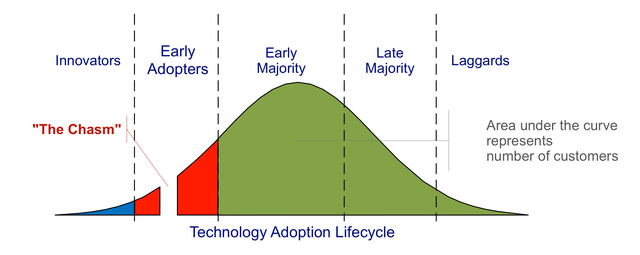
The Adoption Curve Link to heading
The adoption curve illustrates how new technologies and ideas spread through a population over time. It typically follows an S-curve pattern, where:
- Innovators (2.5% of the population) are the first to adopt new technologies, often driven by curiosity and a desire to experiment.
- Early Adopters (13.5%) follow, as they see the potential benefits and are willing to take calculated risks.
- Early Majority (34%) adopt the technology as it becomes more mainstream and widely accepted.
- Late Majority (34%) adopt the technology as it becomes the norm, often due to pressure from peers or the need to remain competitive.
- Laggards (16%) are the last to adopt, often due to resistance to change or lack of resources.
Your Situation Link to heading
You’ve likely been an innovator or early adopter in the past, experimenting with new technologies like Laravel and React. However, as you’ve moved on to newer technologies, you’ve found that the job market is still catching up with the older technologies you’ve already left behind. This creates a challenging situation, where you may be too advanced for some companies, but not cutting-edge enough for others. It’s essential to recognize that this is not a personal failing, but rather a natural consequence of the adoption curve.
Strategies to Overcome this Challenge Link to heading
- Highlight your adaptability: Emphasize your ability to learn and adapt to new technologies, as well as your experience with older technologies that are still widely used.
- Focus on problem-solving skills: Instead of solely focusing on specific technologies, highlight your problem-solving skills and ability to apply them to various technologies and domains.
- Target companies that value innovation: Look for companies that prioritize innovation and are more likely to be using cutting-edge technologies.
- Consider consulting or freelance work: As a consultant or freelancer, you can work with various clients and projects, allowing you to apply your skills to a range of technologies and domains.
- Stay connected with the community: Engage with online communities, attend conferences, and participate in meetups to stay up-to-date with the latest developments and network with like-minded professionals.
Remember, your experience and skills are valuable, and with the right approach, you can find opportunities that match your expertise.